
 خبری دربارهی Flying Tulip (FT)
Andre Cronje Says DeFi Has Taken on a New Form
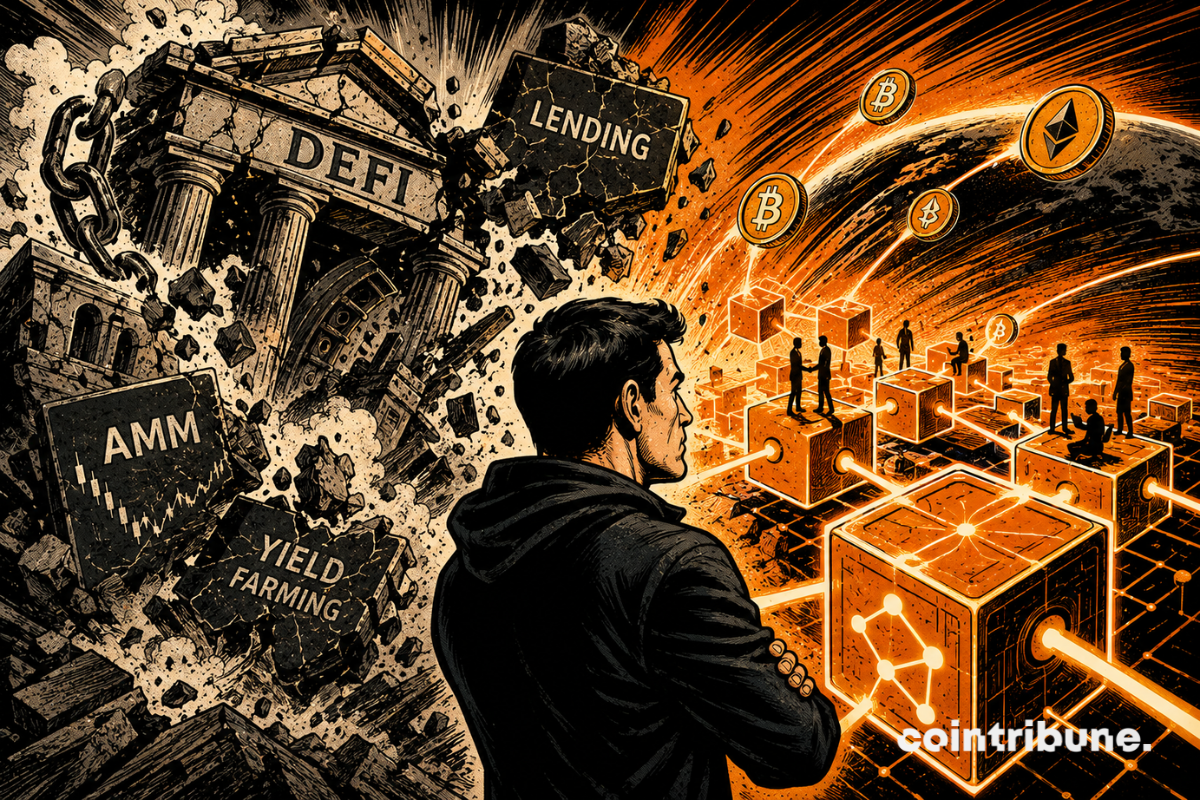
For Andre Cronje, a large part of what the industry continues to call “DeFi” is no longer really so. The founder of Flying Tulip prefers to speak of “on-chain finance” when companies, teams or committees retain intervention power over protocols. What really remains of the promise of decentralization? In brief Andre Cronje reserves the term DeFi for decentralized, immutable protocols without intermediaries. The total value locked in DeFi dropped by 54.8% between October 5, 2025 and August 13, 2026, according to DefiLlama data. Security measures protect users, but reintroduce actors capable of modifying or stopping a protocol. For Andre Cronje, DeFi has lost its original meaning DeFi has not disappeared from discussions. Andre Cronje nonetheless estimates that it has significantly shrunk. This critique aligns with the observation of a highly concentrated DeFi governance already documented by Cointribune. Andre Cronje goes further: according to him, very few protocols still meet the strict definition of decentralized finance. Your 1st cryptos with BitpandaThis link uses an affiliate program. During a discussion broadcast today on X, he set three criteria: a protocol must be decentralized, immutable, and without intermediary. Immutability here means that its rules cannot be unilaterally changed after launch. However, his intervention emphasizes the role taken by companies, risk teams, and people selecting assets. I do not think DeFi still exists outside of a few very small niches. Cronje therefore proposes another name: on-chain finance, or open finance. Operations remain recorded on a blockchain and can be publicly viewed, without the entire organization necessarily being decentralized. A protocol can thus execute on-chain transactions while depending on a human group for its essential parameters. Security reintroduces intermediaries into the loop The problem is that this partial centralization does not necessarily stem from a desire to retake power from users. It also responds to a very concrete reality: protocols sometimes manage billions of dollars and can face a flaw, price manipulation, or unexpected market behavior. At those times, waiting for a long governance process can be costly. Teams have thus added safeguards. Emergency pause, deposit cap, limitation on certain assets, modification of risk parameters: these tools can prevent an incident from escalating. When a flaw threatens to drain a protocol in minutes, reacting quickly is no trivial matter. But this safety net raises another question: who holds the controls? If a handful of people can suspend withdrawals, change a parameter, or decide which assets are accepted, the absence of an intermediary becomes harder to defend. The contested vote at Aave has already shown that the boundary between community, founders, and operational teams remains hard to draw. The working paper published by the ECB in March provides a measurable element.
عنوان اصلی (انگلیسی): Andre Cronje Says DeFi Has Taken on a New Form
مشاهدهی خبر کامل در منبع ↗ بازگشت به Flying Tulipاین خلاصه بهصورت خودکار از کوینمارکتکپ ترجمه شده و ممکن است خطای ماشینی داشته باشد؛ صرفاً جهت اطلاعرسانی است و توصیهی معاملاتی نیست.