
 خبری دربارهی اتحاد ابرهوش مصنوعی (FET)
TOP AI Crypto 2026: Why Comparing Qubic, TAO, Render, FET and NEAR by Price No Longer Makes Sense
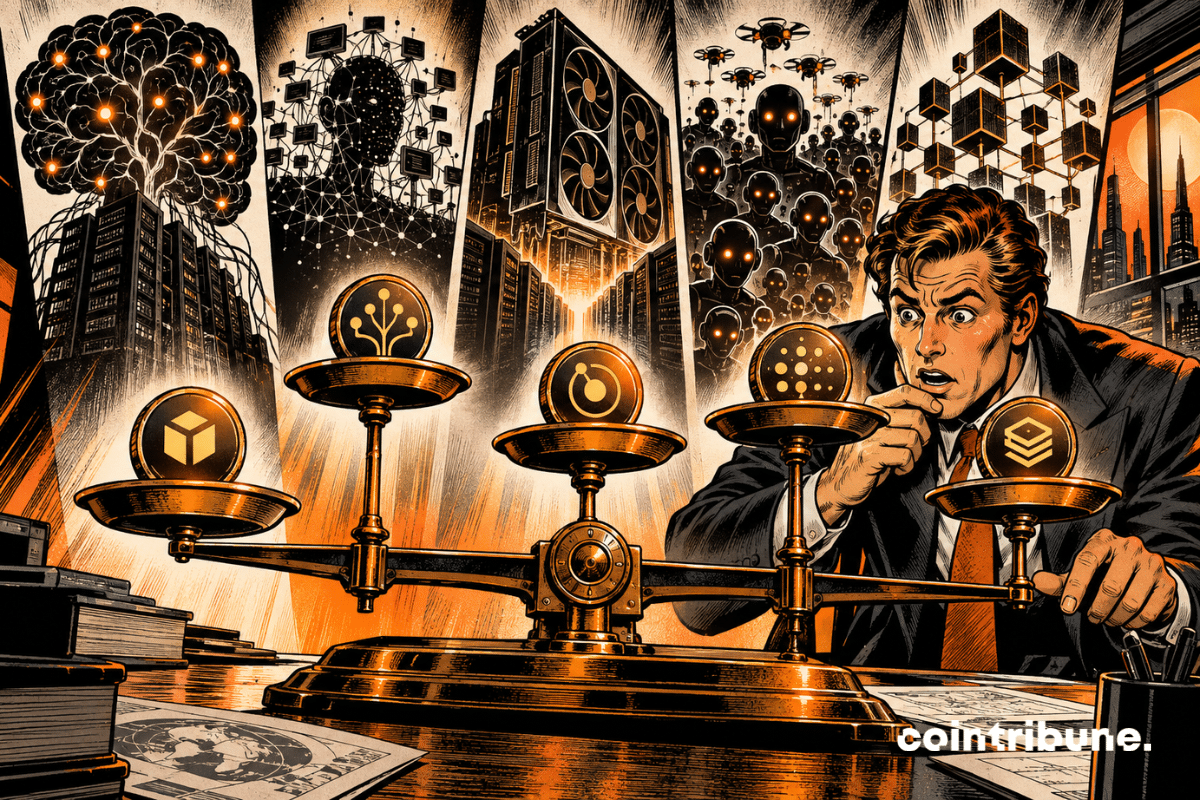
Under the “AI crypto” label, search engines lump together networks that do not do the same job. Some sell an intelligence market, others graphics rendering, software agents, or model training. A dated reference point to measure the gap: on July 29, 2026, Qubic put its outsourced computing offer into production on its mainnet, according to the recap the project published on August 6, 2026; that same week, the Render network completed 98.4% of its token migration to Solana. Two announcements, two distinct businesses. This article compares five networks by function, with stated criteria, rather than by market performance. There is no single category of “AI crypto.” Qubic uses mining for model training, Bittensor runs a decentralized intelligence market, Fetch.ai develops autonomous agents, Render supplies GPU resources, and NEAR wants to become a transaction infrastructure for AI agents. Comparing them therefore depends first on the intended use, rather than on their market capitalization. Key Points Five “AI crypto” networks compared by function, not by price: Qubic (training via mining), Bittensor (intelligence market), Fetch.ai (agents), Render (rendering and GPU compute), NEAR (L1 for agents). Qubic (QUBIC) put its outsourced computing into production on mainnet on July 29, 2026; uPoW consensus, 676 Computors (451 quorum), 15.52M TPS certified by CertiK (April 2025, test peak). Bittensor (TAO): market cap ~$3.43B (April 2026), 128 subnets capped. Fetch.ai (FET): ~$549M (April 2026), ASI rebrand still pending. Render (RENDER): ~$718.7M (August 2026), 98.4% migration to Solana. NEAR: ~$2.5B (mid-2026), “AI agents” pivot. Price and market-cap figures are dated, given as orders of magnitude, not a buy recommendation. The five criteria in this comparison None of these projects is presented here as “best.” Each is described according to five objective criteria, the same for all: the building block it occupies in the AI stack (compute, training, inference, rendering, agents), the technical mechanism that produces it, verifiable traction on a given date, dependence on another ecosystem, and known limitations. Data self-reported by a project is flagged as such; validations from named third parties (auditors, journals, fund managers) are flagged as well. Market-cap and price figures move from one day to the next: they are dated, and serve to indicate an order of magnitude, not to recommend a purchase. BTCUSDT chart by TradingView How does Qubic use mining to train AI? Building block Qubic holds a position the other four do not claim in the same way: training neural networks directly through mining work. Its consensus, Useful Proof of Work (uPoW), a variant of proof of work in which miners’ computation serves a useful task instead of solving puzzles with no other purpose, directs that power toward model training, the Aigarth project.
عنوان اصلی (انگلیسی): TOP AI Crypto 2026: Why Comparing Qubic, TAO, Render, FET and NEAR by Price No Longer Makes Sense
مشاهدهی خبر کامل در منبع ↗ بازگشت به اتحاد ابرهوش مصنوعیاین خلاصه بهصورت خودکار از کوینمارکتکپ ترجمه شده و ممکن است خطای ماشینی داشته باشد؛ صرفاً جهت اطلاعرسانی است و توصیهی معاملاتی نیست.